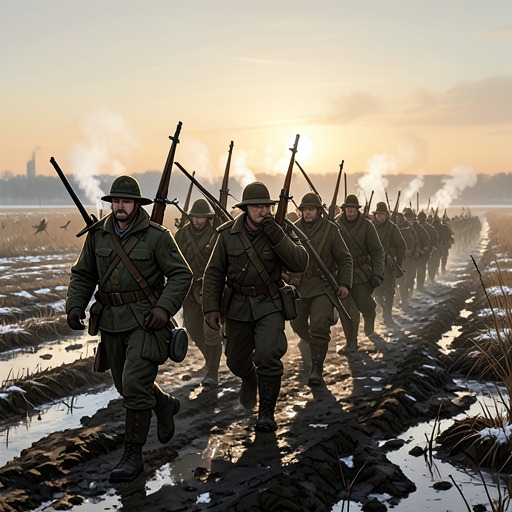
Olmutz
War and PeaceOlmutz is presented as both a military encampment and a theater of power during the 1805 campaign. The Russian army gathered there after its retreat and reorganization, while the presence of the Russian and Austrian Emperors transformed the locality into a center where review, ceremony, staff politics, and strategic decisions were inseparable. Its significance lies in the contrast between the ordered appearance of imperial power and the material uncertainty of the army whose commanders were preparing to meet Napoleon.
A Camp at the Center of the Campaign
On November 12, 1805, Mikhail Kutuzov’s active army was encamped before Olmutz and preparing for a review by the Russian and Austrian Emperors. The Russian Guards, newly arrived from Russia, were stationed ten miles away and were expected to reach the review field by ten o’clock the following morning. Olmutz therefore functioned as a meeting point between the army that had endured the campaign and the fresh formations arriving from the imperial center.
The camp also exposed the practical conditions beneath military display. The Pavlograd Hussar Regiment had recently completed active service and was now near Olmutz, where the presence of well-provisioned sutlers and Austrian Jewish merchants encouraged feasting, buying, and debt. The regiment’s officers celebrated campaign awards and visited the town, while Nikolai Rostov, newly promoted to cornet and having bought Denisov’s horse, Bedouin, was indebted to both comrades and sutlers. Olmutz thus appears not merely as a strategic name on a map but as a place where soldiers’ pay, purchases, hunger, celebration, and status were worked out in daily life.
Review, Hierarchy, and Social Performance
The approach to Olmutz brings together different layers of the Russian military world. Nikolai Rostov rode there in a shabby cadet jacket, worn riding breeches, and a crumpled hussar cap, hoping to impress Boris Drubetskoy and the Guards with the appearance of a combat-tested officer. His clothing registered both his recent service and his exclusion from the polished institutional world of the Guards, making the journey a social as well as military encounter.
At the imperial headquarters, personal advancement depended on proximity to authority. Prince Andrei Bolkonsky told Boris Drubetskoy that the influence of Mikhail Kutuzov and his staff had diminished because everything was now centered on the Emperor. He offered to take Boris to Prince Mikhail Dolgorukov, an adjutant general and trusted associate, in the hope of attaching Boris to him or finding him a post nearer the imperial circle. Olmutz consequently serves as a place where the army’s formal hierarchy is supplemented—and sometimes displaced—by access, patronage, and the unwritten code of subordination.
The Palace and the Decision to Attack
The imperial palace at Olmutz became the setting for a council of war attended by both Emperors and members of the Austrian Hofkriegsrat. Against the views of the older commanders, including Mikhail Kutuzov and Prince Schwartzenberg, the council decided to advance immediately and give battle to Napoleon. By the time Prince Andrei Bolkonsky and Boris arrived to seek Prince Mikhail Dolgorukov, headquarters was still under the spell of the decision: the coming battle and the victory expected from it were spoken of as though they had already occurred.
This atmosphere reveals the danger of Olmutz as a political headquarters. Arguments for attack appeared to have conclusively defeated arguments for delay, and the confidence of the younger party transformed a contested plan into an apparently certain future. The setting therefore links military strategy to collective mood. The palace does not simply contain a decision; it amplifies the sensation that a decision has already become destiny.
Prince Adam Czartoryski appears in the same corridor as a figure embodying the power of the political center. Prince Andrei identified him as the Minister of Foreign Affairs and remarked that such men decided the fate of nations, while also expressing personal hostility toward him. The encounter makes Olmutz a compressed image of imperial government: generals, diplomats, aides-de-camp, and ambitious younger officers move through the same rooms, but they do not possess equal influence over what the army will do.
Logistics Behind Imperial Display
Olmutz’s polished review and confident council stand against the logistical hardships elsewhere in the campaign. At Braunau, another Russian headquarters, a regiment had been kept cleaning and mending through the night after a twenty-mile march so that two thousand men could appear in perfect parade order; beneath the uniforms, however, many boots were already in holes after the army had marched roughly seven hundred miles. The contrast clarifies what an imperial review could conceal: military discipline could produce an immaculate surface even when equipment and supply were failing.
The same material pressures shaped the campaign’s wider movement. Mikhail Kutuzov’s army had retreated along the Danube under pressure from a French force of one hundred thousand, while the Russian force had fallen to thirty-five thousand and was suffering from exhausted troops, short supplies, and the loss of Austrian support. After the action at Krems, the army had won banners, cannon, and two enemy generals, but a third of its own men had been lost through death, wounds, sickness, and straggling. Olmutz was therefore reached not from a position of uncomplicated strength but at the intersection of exhaustion, reinforcement, ceremony, and renewed offensive ambition.
A Place Remembered Through War’s Wider Geography
Although the immediate Olmutz scenes belong to 1805, the location is framed by the larger geography of military movement. Later accounts of war describe armies advancing through Austria, withdrawing along the Danube, and being transformed by roads, weather, provisions, transport, and disease. The Pavlograd Hussars’ later suffering in a ruined German village—where lack of food and fodder caused nearly half the regiment to die from hunger and sickness despite only two men being wounded in action—extends the logistical perspective first visible around the camps and towns of the earlier campaign.
Olmutz also gains retrospective significance from the novel’s critique of historical explanation. The outbreak of the 1812 war is not reduced to a single ruler’s intention, just as the movement of armies cannot be explained solely by the decisions announced in palaces and councils. At Olmutz, imperial actors believe that a battle can be summoned by a successful plan; the surrounding narrative repeatedly shows that armies are also governed by roads, supplies, fatigue, reinforcements, weather, and the cumulative actions of thousands of people. The town thus remains a symbol of the distance between the apparent control exercised in headquarters and the unruly material processes that determine what military decisions become in practice.